
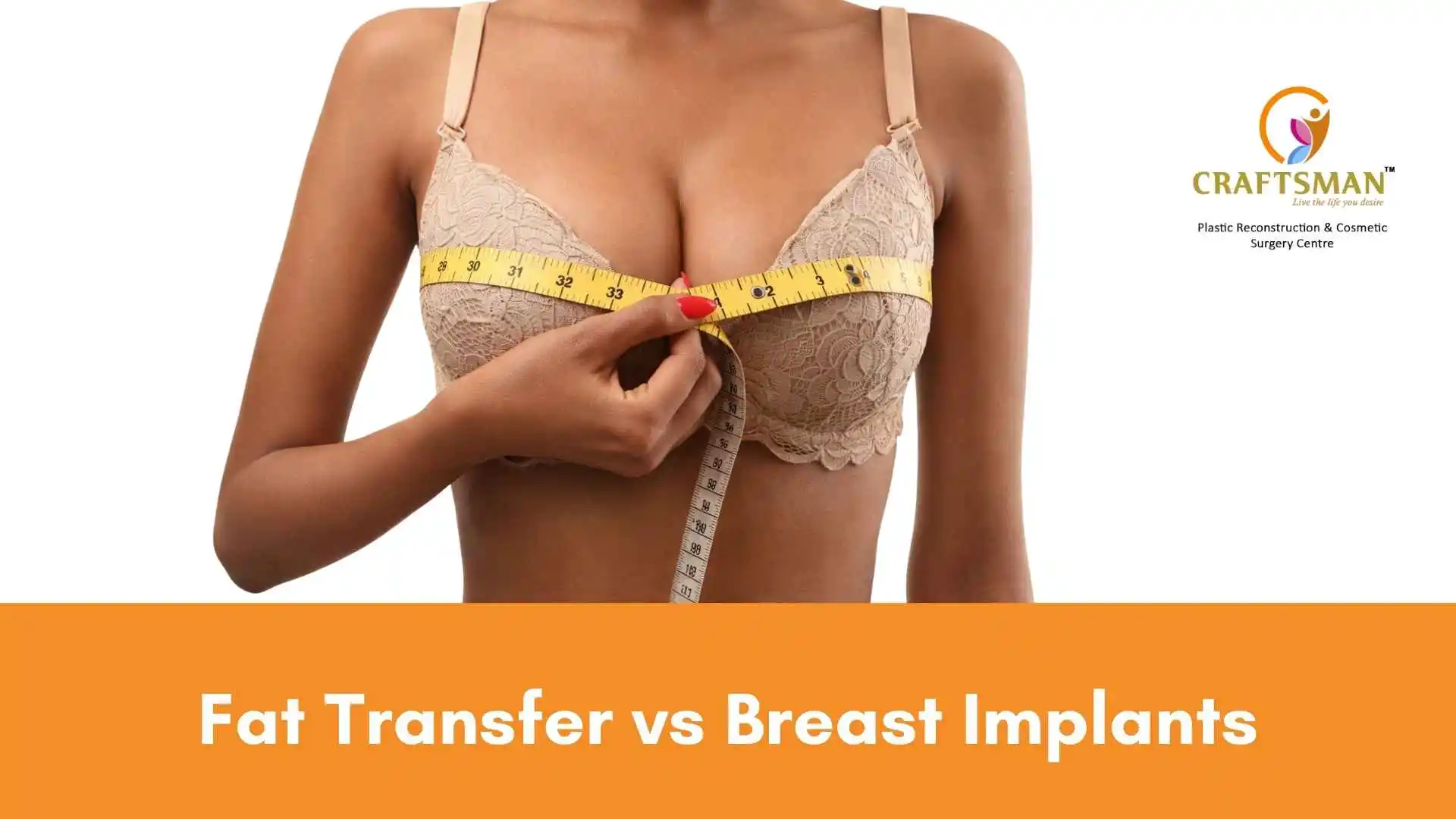
Fat Transfer vs Breast Implants – Pros, Cons & Best Option

Reviewed by - Dr Nitin Ghag
MBBS, DNB - General Surgery, DNB - Plastic Surgery
Plastic Surgeon
22 Years Experience Overall (4 years as specialist)
It may be hard to decide between fat transfer vs breast implants, even when you are familiar with both procedures. Most women who study breast augmentation come to a stage when they understand what each has to offer–but can not determine which one best suits her. This guide simplifies the distinctions at an outcome, safety and long-term expectation level in order to allow you to make a well-informed decision.
Fat Transfer vs Breast Implants: What Is the Difference?
The main difference between fat transfer vs breast implants lies in how breast volume is added.
Breast implants enlarge the breasts with the help of silicone or saline devices that are inserted during breast implant. Fat transfer, however, takes your own body fat to improve the breasts, and is therefore a more natural, tissue-based method.
In easy terms, breast implants depend on medical devices to add volume and fat transfer depends on transferred fat to add to the other breast tissue.
Both are effective methods of breast augmentation, but they produce different results and suit different goals.
Why Choosing Between Fat Transfer and Breast Implants Can Be Confusing
Many patients feel unsure because both options are widely discussed as safe and effective breast surgeries. The confusion typically arises through attempting to compromise various priorities at the same time, which are, desired size of the breast, safety, durability, and whether the breasts are to feel as natural as possible.
Other women desire a radical alteration in the size of their breast whereas others desire a subtle enhancement of their breast. Others do not know how long the results will last, or whether the implants or fat transfer will be more appropriate to their body. Such uncertainty is natural and sometimes an indication of the necessity of more comprehensive comparison instead of counter-intuitive information.
How Breast Implants Work for Breast Augmentation
Breast implants are made in such a manner that they dramatically boost the volume and shape of the breast. In implanting the breast, one can use implants either beneath the breast tissue or beneath the chest muscle, which depends on the anatomy and the appearance desired.
Patients usually have the option of silicone and saline implants. Silicone implants are usually softer and more natural whereas saline implants are filled with sterile saltwater and can be adjusted to size during Breast Implant surgery.
Due to the fact that implants provide a good choice of breast size and shape, they are usually considered by women who want to experience a significant and reliable growth of the size of their breast. The breast implants can have long lasting results but they are not lifetime devices and may need monitoring or replacement in future.
How Fat Transfer to the Breasts Works
Fat transfer to the breasts, or fat grafting or autologous fat transfer is a procedure that uses fat on one area of the body to enhance the breasts. The procedure starts when the surgeons extract fat through liposuction to slim down the parts of the body like the abdomen or thighs.
The harvested fat is then purified and then injected into the breast tissue with a lot of care. Since it is a transfer of your own fat cells, the outcome blends itself with breast tissue.
Women who desire natural breast augmentation and would prefer the use of body fat over implants usually prefer this option of fat transfer surgery. However, fat transfer requires adequate donor fat, and not all transferred fat survives permanently.
Breast Size Results: Fat Transfer vs Breast Implants
There is a great difference in terms of breast size expectation between the two choices.
Fat transfer normally causes a slight growth in the size of the breast. It suits best those women who do not want a radical change but only slight improvements. Since the body may absorb some fat, the ultimate size of the breast may be different.
In contrast, breast implants are known to enable surgeons to consistently add one or more cup sizes to the breast. Implantation breast augmentation is more predictable and consistent where the breast size is of significant concern.
The amount of volume that you desire to have is one of the most crucial aspects when deciding on whether to use implants or fat transfer.
Breast Shape and Feel: Natural Results Compared
Fat transfer will increase the contours of existing forms in the breast, and in most cases, this may give the breast a softer feel that is almost similar to that of a natural breast. Due to the fact that the transferred fat is combined with the natural breast tissue, most patients believe that the breasts are really natural and feel very natural.
Breast implants are more dramatic in shaping the breast and give it structure and projection. Although modern implants may seem very natural, particularly when they are inserted underneath the muscle, they might be firmer than fat enhanced breasts.
This texture and form difference is usually a significant factor in the choice that is made.
How Long Do Fat Transfer and Breast Implants Last?
Most patients are concerned with longevity.
As the fat is transferred, some of the fat injected remains, but fat can be absorbed with time. This poses a risk of fat reabsorption and some patients may need further fat grafting procedures to sustain them.
Breast implants offer a more reliable volume with time, yet implants are not permanent. Breast implants can be replaced after some time and some women opt to get them removed later in their lives as it is a choice or even a medical necessity.
Both are choices that have various long-term implications than a direct winner.
Safety Considerations for Fat Transfer vs Breast Implants
Both procedures are considered safe when performed by qualified surgeons, but their risks differ.
Breast implant surgery has its own risks which include foreign material, implant rupture or capsular contracture. Fat transfer does not involve placing implants but puts a variation in the extent of fat survival. Fat grafting may require repeat treatments, which some patients consider in their decision.
Some feel fat transfer has a better safety perception because it uses the body’s own tissue, while others prefer the predictability of implants despite their maintenance needs.
Can You Combine Breast Implants and Fat Transfer?
Breast implants and fat transfer can be done together in some instances.
This method involves the use of implants to form the volume and fat is enclosed around the implant to enhance the contour and softness. Breast fat can be transferred along with the implants in order to produce a more natural transition between the implant and the breast tissue.
The combination procedures are suggested frequently to the patients who desire the size and softer, more natural touch.
Body Type and Fat Availability: Who Is a Good Candidate?
Availability of fats is a significant factor in the choice of implants or fat transfer.
The procedure needs a sufficient donor fat to transfer the fat. In other parts of the body, women who have excess fat are more likely to be good candidates in terms of fat transfer. In extremely skinny patients, implants are the sole method of realizing a significant breast augmentation.
This renders body type as one of the practical determiners.
Do You Need a Breast Lift With Fat Transfer or Implants?
In case there is sagging, a breast lift can be suggested.
Mild lifting effect may be observed with breast implants and fat transfer alone fails to remedy serious drooping. A breast lift in most occasions is used in conjunction with implants or fat transfers to attain the best shape and position.
The combination of the procedures is typical in contemporary surgeries of the breast and relies on the personal anatomy.
Choosing Between Breast Implants or Fat Transfer
When choosing between breast implants or fat transfer, consider:
- What size of breast do you desire?
- Whether you prioritize natural feel or predictable volume
- Your comfort with long-term maintenance
- Your available body fat
Fat transfer is a personal choice, and transfer is a personal decision—just like choosing implants. The right option depends on your goals, anatomy, and expectations.
Conclusion
Implantation of the breast gives reliable predictability of size, shape, and long-term volume. Fat transfer breast augmentation provides a natural look and feel with minimal enhancement with your own fat.
Neither option is universally better. Understanding the differences allows you to choose the approach that best aligns with your body and your vision for breast enhancement.
FAQs
Is fat transfer better than breast implants?
Fat transfer can be better for patients seeking subtle, natural-looking enhancement without implants, while breast implants are better for those wanting a larger, more predictable size increase.
How long does fat transfer breast augmentation last?
Once the transferred fat survives and establishes blood supply, results can be long-lasting, though some fat loss is expected in the first few months.
Do breast implants last longer than fat transfer?
Breast implants are durable but not lifetime devices and may require replacement, while fat transfer does not involve implants but offers more modest volume.
Can you go bigger with implants or fat transfer?
Implants allow for significantly greater size increases, while fat transfer is typically limited to about one cup size per procedure.
How do I choose between fat transfer and breast implants?
The best choice depends on your body type, aesthetic goals, available donor fat, and tolerance for implants—making consultation with a qualified plastic surgeon essential.
Further Reading
Armpit Fat Removal: Causes, Options, and What Actually Works


Tummy Tuck After a C-Section – When to Get a Tummy Tuck
View More Services